
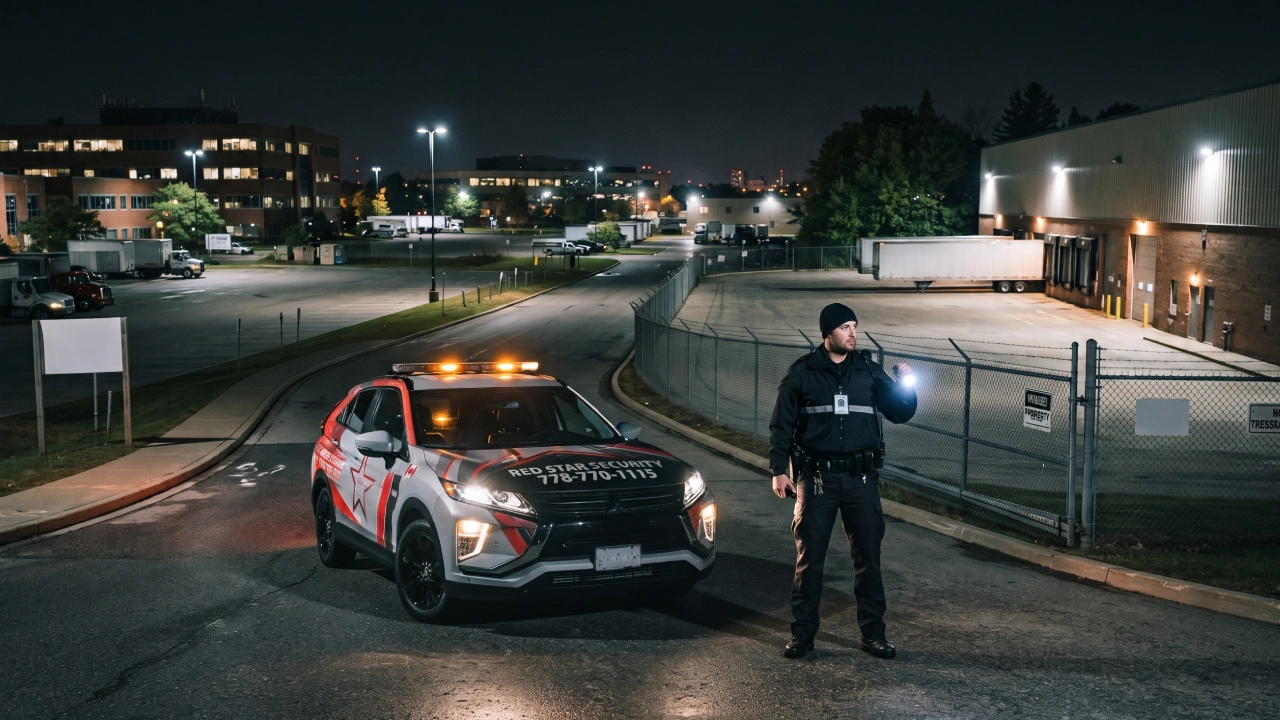
When One Watch Point Is Not Enough for a Large Property
One quiet night can raise a serious question: who was watching the property?
A large Langley property may stretch across parking areas, loading zones, gates, storage spaces, exterior doors, and several buildings. After business hours, those areas can become difficult to check from one fixed position.
That is where Mobile Patrol Security can play a practical role. Our patrol officers move through different parts of a property, checking conditions that may otherwise go unnoticed.
A gate may be open. A vehicle may remain where it should not. A section of fencing may show fresh damage. A secondary entrance may be unsecured.
These details can matter.
So, how can mobile patrols monitor a large property without relying on one observation point? Here are five methods worth knowing.
Why Large Properties Can Become Difficult to Monitor
Size creates a simple problem: there is more ground to cover.
A small commercial building may have one main entrance and a compact parking area. A large industrial property can have several vehicle entrances, loading areas, storage sections, employee parking, perimeter fencing, and secondary structures.
One person standing at a single location cannot see all of those areas at once.
Consider a warehouse property in Langley. During the day, employees, suppliers, contractors, and visitors may move through different access points. After hours, activity drops. Yet the property itself remains spread across a large area.
Several areas may receive little attention.
These can include:
- Rear parking sections
- Service entrances
- Loading zones
- Perimeter fencing
- Vehicle gates
- Storage areas
- Secondary buildings
- Exterior walkways
- Construction sections
Cameras can provide useful visual coverage, but they do not physically move around the site. Mobile security patrols add a physical presence that can check different areas during scheduled visits.
That distinction matters when property managers need eyes on more than one location.
5 Ways Mobile Patrol Security Can Monitor Large Properties
Large properties need more than a brief look at the main entrance.
Our patrol officers can move through different sections of a site and look for conditions that require attention. The exact patrol process depends on the property layout, access points, operating hours, and instructions provided by the client.
Here are five practical ways mobile patrols can support property monitoring.
1. Routine Vehicle Patrols
A patrol vehicle can cover ground quickly across a large property.
Instead of keeping an officer at one fixed location, our patrol officers can move through designated areas during a property check. This can include the main entrance, parking areas, access roads, loading zones, and exterior sections.
For example, imagine an industrial property with a large rear yard and several buildings. A patrol vehicle can pass through those sections during scheduled visits.
During the patrol, officers may look for:
- Unusual vehicles
- Open access points
- Damaged fencing
- Unsecured exterior doors
- Signs of property damage
- Unusual activity
- Changes around restricted areas
The purpose is not to assume that every unusual condition represents a security incident.
Instead, our patrol officers assess what they see and follow the established reporting or response procedures.
Vehicle patrols can also create a visible security presence. Someone approaching a property may notice that the site receives routine patrol activity.
For property managers, the bigger advantage is coverage across multiple areas rather than observation from one fixed position.
2. Randomized Patrol Patterns
Predictability can create monitoring gaps.
If patrol activity always happens at exactly the same time and follows exactly the same route, people may become familiar with the pattern.
That does not mean a fixed schedule has no value. Scheduled patrols provide consistency. However, varying routes or timing where appropriate can add another layer of observation.
Our patrol officers may vary which sections receive attention first, depending on the property’s instructions and circumstances.
One visit may begin near the front entrance. Another may focus first on the rear perimeter or loading area.
This approach can be useful when a property manager has noticed:
- Repeated unusual vehicle activity
- An open gate after hours
- Movement around restricted areas
- Recurring property damage
- A particular area receiving little attention
Randomization does not guarantee that an incident will be prevented. Its purpose is to reduce reliance on one predictable observation pattern.
For a large property, that change can make routine monitoring less rigid.
3. Perimeter and Access Point Checks
A property can look secure from the street while a problem sits somewhere along its boundary.
That is why perimeter checks can form an important part of mobile security patrols.
Our patrol officers can inspect designated sections of fencing, gates, vehicle entrances, service entrances, and exterior doors during property checks.
Small changes can provide useful information.
A gate that should be closed may be standing open. A fence panel may appear damaged. A service door may not be secured as expected.
On a construction site, the situation can be even more noticeable. Temporary fencing, equipment areas, material storage sections, and unfinished structures can create multiple access points.
During a patrol, officers can check the areas identified in the site instructions and document unusual conditions.
The process can also help property managers identify recurring issues.
If the same gate is repeatedly found open, for example, the issue may not simply be a one-time oversight. It could point to a maintenance problem, access-control issue, or process gap that requires attention.
4. Parking Lot and Exterior Monitoring
A large parking area can become an easy place to overlook.
Rows of vehicles may extend around a commercial building, apartment complex, warehouse, or industrial facility. Some sections may sit close to entrances, while others may be far from regular foot traffic.
That creates a monitoring challenge.
Our patrol officers can check designated parking areas during mobile security patrols and pay attention to conditions such as:
- Vehicles remaining after operating hours
- Isolated parking sections
- Poorly visible areas
- Exterior doors
- Walkways
- Lighting conditions
- Unusual activity around vehicles
The goal is not to treat every parked vehicle as suspicious.
Context matters.
A vehicle may belong to an employee working late, a contractor, or an authorized visitor. Officers can assess the situation based on the property’s procedures rather than making assumptions.
For apartment complexes, parking facilities, commercial centres, and industrial sites, exterior checks can also bring attention to areas that receive little routine foot traffic.
Sometimes the issue is not a person at all.
A damaged light, blocked walkway, unsecured door, or fallen section of fencing can also become important property-security observations.
5. Incident Reporting and Property Checks
Seeing something unusual is only part of the process.
Knowing what was observed, where it happened, and when it was noticed can help property managers review what happened later.
During property patrols, our officers can document conditions such as:
- Damaged locks
- Open gates
- Broken fencing
- Unusual vehicles
- Signs of attempted access
- Property damage
- Suspicious activity
Clear reporting can create a record of property conditions at the time of a patrol.
Consider a manager arriving Monday morning and finding damage near a service entrance.
Without earlier observations, it may be difficult to establish when the condition first appeared.
Regular property checks and incident reports can provide useful context.
The report does not replace an investigation when one is required. Instead, it gives the property manager information about what the patrol officer observed and when.
For large properties, that record can also help identify recurring patterns across different areas.
What Can Go Wrong When Large Properties Are Left Unchecked
Here is where a quiet property can become difficult to read.
An unsecured gate may remain open for hours.
A vehicle may stay in an isolated section long after normal operating hours.
A damaged fence may go unnoticed because nobody regularly walks past that area.
A restricted door may be left unsecured at the end of the day.
None of these situations automatically means a serious incident has occurred.
However, each one creates a condition worth noticing.
Imagine a property manager discovering damage on Tuesday morning. The main entrance looks fine. The front parking area looks normal. Yet a rear section shows signs of access.
Without routine checks, the timeline may remain unclear.
Mobile patrols can help by placing officers across different parts of the property at scheduled intervals. When an unusual condition appears, officers can follow the property’s procedures and document what they find.
Security monitoring is therefore not about claiming that every incident can be stopped.
It is about increasing observation across areas that might otherwise receive limited attention.
When Should a Property Consider Mobile Patrols?
Mobile patrols can make sense when a property has more ground to cover than one fixed position can reasonably observe.
This may include:
- Large commercial properties
- Industrial sites
- Construction sites
- Shopping centres
- Apartment complexes
- Warehouses
- Parking facilities
- Vacant properties
- Multi-building facilities
- Properties with wide perimeters
A construction site, for instance, may contain several unfinished structures, equipment areas, temporary gates, material storage zones, and perimeter sections.
A warehouse may have loading bays, employee parking, delivery entrances, and rear access roads.
An apartment complex may have multiple buildings and parking areas spread across one site.
Each property presents a different monitoring challenge.
Patrol frequency should therefore depend on factors such as the site layout, operating hours, number of access points, previous incidents, and the property’s security requirements.
There is no single patrol schedule that fits every site.
Mobile Patrol Security in Langley
Large properties across Langley can present practical monitoring challenges simply because of their size and layout.
Commercial and industrial properties may include broad exterior areas, parking lots, loading zones, warehouses, access roads, and multiple entrances.
Construction properties can add another layer. Temporary fencing, unfinished buildings, equipment storage, and changing site conditions may create access points that need routine checks.
For property managers, the question is often simple:
Who is checking the areas that nobody regularly sees?
A mobile patrol can move between designated sections rather than remaining at one fixed location.
For a Langley warehouse, that could mean checking the loading area, rear perimeter, vehicle entrance, and parking section.
For a multi-building property, officers can move between structures during scheduled patrols.
For a construction site, checks may focus on gates, fencing, equipment areas, and signs of unauthorized access.
The exact process should match the property rather than follow a generic route.
Common Mistakes Property Managers Make
The biggest security gap may not always be a dramatic one.
Sometimes, it is simply an area nobody checks.
One common mistake is relying on a single fixed observation point. A guard positioned near the main entrance may have limited visibility of a rear parking area or distant perimeter.
Another mistake is using exactly the same patrol route every time. Consistency matters, but rigid patterns may leave other sections receiving less attention.
Other common gaps include:
- Checking only the main entrance
- Ignoring perimeter areas
- Overlooking parking sections
- Failing to document unusual conditions
- Leaving secondary access points unchecked
- Waiting until after an incident to review weak areas
Consider an open gate.
If someone notices it during a routine patrol, the issue can be reported according to the property’s procedures.
If nobody checks the gate until the next morning, the property manager may only discover the problem after several hours.
The same principle applies to fencing, doors, lighting, vehicles, and exterior areas.
Routine observation gives property managers more information about what is happening across the site.
FAQs
What is Mobile Patrol Security?
Mobile Patrol Security uses patrol vehicles and officers to monitor designated areas of a property. Officers can move between entrances, parking areas, perimeter sections, buildings, and other locations identified in the patrol instructions.
How can mobile patrols monitor a large property?
Patrol officers can travel between different sections of the property during scheduled checks. Depending on the site, this may include access points, parking areas, loading zones, exterior doors, fences, gates, and secondary buildings.
How often should a large property be patrolled?
There is no universal frequency. Patrol schedules can depend on the property’s size, layout, operating hours, access points, previous incidents, and security requirements.
A property manager should assess which areas need routine checks and how often those checks should occur.
Can mobile patrols replace on-site security officers?
Sometimes mobile patrols can complement other security measures, while some properties may require officers stationed on-site.
The right arrangement depends on the property’s layout, operating needs, access points, and security plan.
What do patrol officers check during a property patrol?
Checks may include entrances, gates, fences, exterior doors, vehicles, parking areas, loading zones, restricted sections, and signs of unusual activity.
Officers follow the property’s instructions and document conditions that require attention.
Are mobile patrols useful for properties in Langley?
They can be useful for large Langley properties where multiple exterior areas require periodic checks. Commercial sites, industrial properties, construction sites, warehouses, apartment complexes, and multi-building facilities may all have areas that are difficult to monitor from one fixed position.
Moving Forward
Large properties can contain dozens of areas that deserve attention.
Entrances, gates, parking lots, loading zones, fences, storage sections, exterior doors, and secondary buildings can all present different monitoring needs. Mobile Patrol Security provides a way to move through those areas rather than relying on one fixed observation point. The five methods discussed here include routine vehicle patrols, varied patrol patterns, perimeter checks, parking and exterior monitoring, and clear incident reporting.
No patrol can guarantee that every security incident will be prevented. What mobile patrols can do is place trained patrol officers in different parts of a property and document conditions that may require attention.
For properties in Langley, that physical coverage can be useful when the site is large, spread out, or difficult to monitor from one location. Red Star Security Ltd provides mobile patrol coverage for properties in Langley and surrounding areas. Our business address is 5896 186a St, Surrey, BC V3S 7Z9, Canada.
If you are reviewing security coverage for a large commercial, industrial, residential, construction, parking, or multi-building property, call Red Star Security Ltd at +1 778-770-1115 to discuss mobile patrol coverage for your Langley property.





No comment